
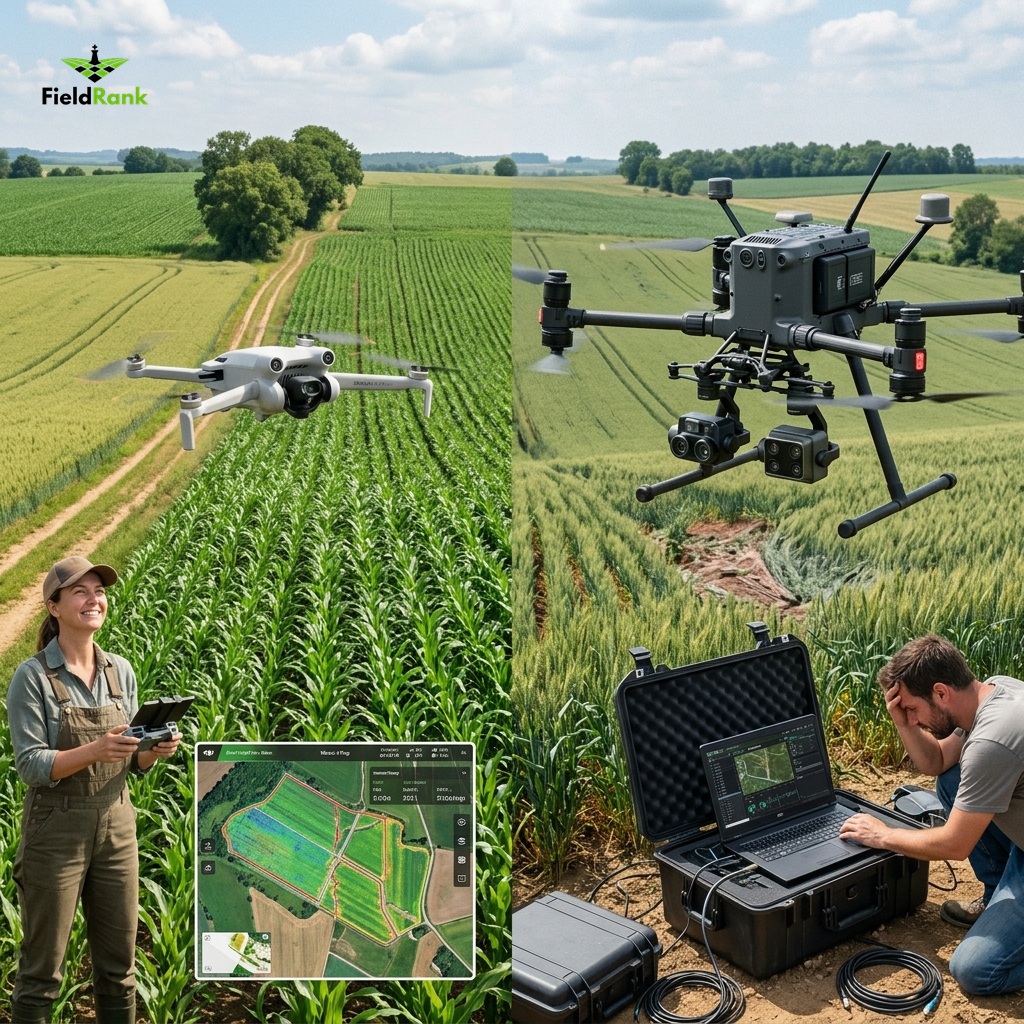
Why It's Not Worth Buying a Multispectral Drone for Agricultural Management
Discover why common RGB drones, combined with intelligent processing, outperform the cost and complexity of multispectral drones for routine agricultural management.
Digital agriculture is going through a transition. For years, we have been bombarded with the idea that to practice true precision agriculture, producers would need to invest tens of thousands of dollars in drones equipped with multispectral cameras. The promise was seductive: "see the invisible" and detect stress before the human eye could even notice it.
However, when we look at the reality of routine field activities, this narrative is losing steam. The question many agricultural managers are asking today is not about which sensor is more "technological," but rather: "what actually brings return on investment (ROI) and operational efficiency?".
In this article, we will analyze why, for the vast majority of management decisions—such as fertilizer application, identifying planting failures, and vigor monitoring—the use of common RGB drones, combined with intelligent processing, is not only sufficient but is the most rational and efficient choice.
What is multispectral sensing and why did it become an "object of desire"?
To understand the gap between theory and practice, we must first define what multispectral sensing is. Unlike a conventional RGB camera, which captures only visible light bands (Red, Green, and Blue), a multispectral sensor captures additional bands, such as Near-Infrared (NIR) and Red-Edge.
These bands are fundamental for calculating indices like NDVI (Normalized Difference Vegetation Index). The scientific logic is sound: healthy plants reflect much more near-infrared light than stressed plants. Therefore, by measuring this reflectance, we can quantify photosynthetic vigor with scientific precision.
This technology was born in academic and research environments. In studies of advanced phytopathology, genetic improvement, or severe water stress experiments, spectral precision is indispensable. The problem arises when this laboratory necessity is sold as a requirement for daily farm management. The market created a "multispectral obsession," often ignoring that the complexity of radiometric calibration and the need for heavy processing make this tool a bottleneck, not an accelerator, for the average producer.
The "Hidden Heterogeneity": Why RGB is sufficient for management
The premise that only infrared can reveal the health of a crop is, at the very least, incomplete. The science behind RGB indices, such as VARI (Visible Atmospherically Resistant Index), demonstrates that visible light contains enough valuable information to identify management zones with high precision.
VARI, for example, was developed specifically to be resistant to atmospheric effects, using Red, Green, and Blue bands to estimate the fraction of green vegetation. Comparative studies show that, in terms of identifying distinct regions (areas of high vs. low vigor), the correlation between VARI and multispectral indices like NDVI is extremely high.
For the agricultural manager, what matters is the identification of management zones. If your goal is to know where to apply more or less fertilizer, or where a planting failure exists, the map generated by a common RGB drone—when processed correctly—delivers exactly the same operational answer as a multispectral map. The "hidden heterogeneity" of the field, which so greatly impacts productivity, is revealed just as effectively by RGB.
The invisible cost of the multispectral drone
Beyond technical efficacy, we need to talk about economics. The cost of a multispectral drone is not limited to the purchase price of the equipment. There is an "invisible cost" that many producers only discover after acquisition:
- Accelerated Depreciation: Multispectral equipment is expensive and has a short technological lifespan.
- Operational Complexity: Multispectral sensors require constant radiometric calibration (use of reflectance panels, incident light sensors, etc.). If this calibration is not perfect, the generated data is useless or, worse, misleading.
- The Processing Bottleneck: Multispectral images generate massive data volumes that require computers with powerful GPUs for local processing. Producers who do not have this infrastructure end up depending on third-party services, which increases operational costs and response time.
The revolution of cloud processing and common RGB drones
The true revolution in precision agriculture did not come from a more expensive lens, but from the democratization of processing. Today, consumer drones (like the DJI Mini, Air, or Mavic lines) have extremely high-resolution RGB cameras capable of capturing details that satellites could never reach.
Intelligence, therefore, has migrated from hardware to software. Cloud processing platforms, such as FieldRank, allow producers to transform raw images into variable-rate prescription maps in less than 24 hours. The system subdivides the field into management cells, ranks the vigor of each one, and delivers a file ready for machinery.
This approach reverses the logic: instead of spending a fortune on a drone that requires a PhD to operate, the producer uses the equipment they already own and lets algorithmic intelligence in the cloud do the heavy lifting. It is absolute simplicity in the service of productivity.
When is multispectral actually necessary?
It is fundamental to maintain technical impartiality. Multispectral sensing does have its place. It is vital for:
- Scientific Research: Studies that require the analysis of specific biochemical components of leaves.
- Genetic Improvement: Where detecting minimal reflectance variations is the primary goal.
- Severe Water Stress Studies: Where specific bands can offer insights that RGB cannot capture with the same sensitivity.
However, these applications are light-years away from the reality of routine agricultural activities. For the producer who needs to decide where to apply nitrogen or where to investigate a soil patch, multispectral is often an excess of precision that does not translate into profit.
Conclusion
Precision agriculture should not be measured by the complexity of the equipment, but by the clarity of the decision it allows one to make. Routine agricultural management requires agility, cost-effectiveness, and, above all, practical actions.
By opting for RGB drones and intelligent processing, the producer stops being a "data collector" and becomes a results manager. FieldRank was born with this mission: to democratize precision agriculture, transforming your common drone into a high-performance tool, without the need for prohibitive investments.
Stop guessing. Know the best and worst hectare of your field with absolute simplicity. The future of your productivity is not in an expensive lens, but in the intelligence you apply to the data you already have.