
The End of Average Management: How Individual Acreage Analysis is Redefining Profitability
Discover why managing your crop by the average is a financial mistake and how cellular (grid) analysis turns data into real profit.
Modern agriculture lives in a paradox. We have never had so many technological tools at our disposal, but, paradoxically, many producers still make decisions based on an obsolete metric: the field average. Treating an area of 50, 100, or 500 hectares as a homogeneous unit is not just a simplification; it is a strategy that silently erodes profit margins season after season.
The Illusion of Homogeneity
When a manager applies the same dose of fertilizer, the same seed density, or the same phytosanitary management across the entire field, they are assuming that the crop responds uniformly. However, the reality of the field is a complex mosaic. Variations in soil texture, topography, water retention capacity, and management history create zones with drastically different productive potentials.
Managing by the average is, in practice, managing in the dark. In low-potential areas, you are wasting expensive inputs that the plant lacks the capacity to convert into productivity. In high-potential areas, you are underutilizing the soil, failing to harvest what the land could offer due to a lack of adequate nutritional input. The end result is productivity leveled from the bottom up and a cost per hectare inflated by waste.
The Problem of "Hidden Heterogeneity"
Agronomic science has already consolidated the concept of spatial variability. As pointed out by studies in precision agriculture, the conventional sampling methodology based on average values is inadequate to characterize the real variability of soil and crop properties (Embrapa, 2005).
This "hidden heterogeneity" is not visible to the naked eye in a quick inspection. The human eye, no matter how trained, cannot quantify nutrient variability or soil compaction over large areas. Technologies that deliver only "pretty maps" — such as low-resolution satellite imagery or generic heat maps — fail by not offering actionable diagnostics. They show that variation exists, but they do not explain the cause nor provide the tool for correction.
The Science Behind Cellular Analysis (Grid Ranking)
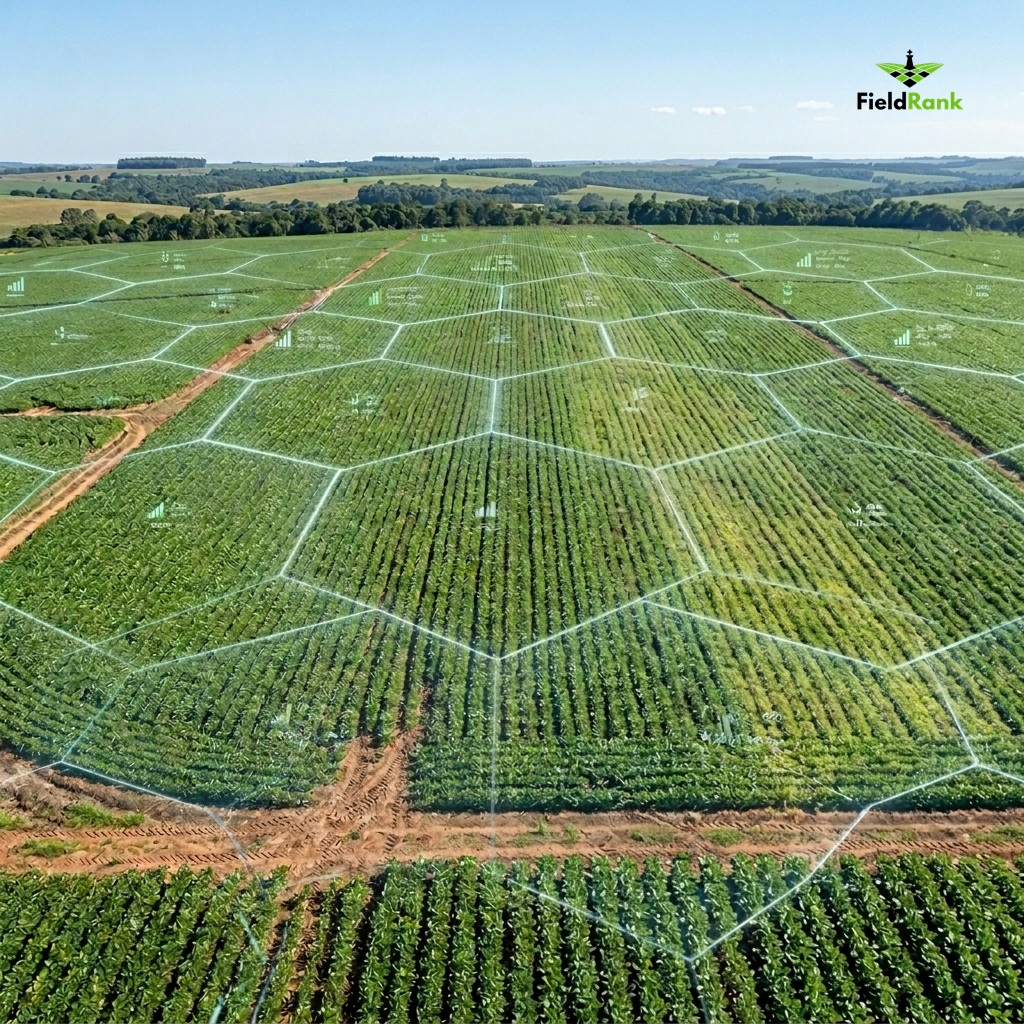
The transition from macro-view to micro-view is the watershed moment for precision agriculture. The Grid Ranking technique (or grid analysis) subdivides the field into discrete management units — cells of 0.25 to 1 hectare.
Unlike management zones based solely on NDVI (which can be misleading as they are sensitive to soil brightness), the use of indices such as the VARI (Visible Atmospherically Resistant Index) allows for robust analysis using common RGB cameras. VARI is designed to emphasize vegetation in the visible spectrum, mitigating atmospheric effects and lighting variations (EOSDA, 2022).
The effectiveness of VARI lies in its ability to evaluate the "greenness" of plants, assuming that greener plants are in better physiological condition. As highlighted in technical research, the error of VARI for vegetation monitoring under conditions of different atmospheric thicknesses is less than 10%, making it an extremely reliable tool for drones equipped with standard RGB sensors (EOSDA, 2022).
Turning Data into Action: The Power of Localized Prescription
Having a map is not the same as having an action plan. The true revolution occurs when data becomes prescription. Variable Rate Application (VRA) is the component that allows the producer to apply the right dose, in the right place, at the right time.
Studies demonstrate that the adoption of variable rate technologies can reduce fertilizer consumption by 15% to 30%, while maintaining or even increasing productivity (AgriJoy, 2026). In practical cases, reallocating resources to higher-potential areas resulted in significant gains, with returns ranging from US$ 20 to US$ 60 per acre in crops like canola, simply by optimizing the fertilization strategy (RealAgriculture, 2025).
The Impact on Operational Efficiency and ROI
Individualized analysis per hectare changes the dynamics of the entire farm:
- Targeted Scouting: Instead of walking kilometers in random inspections, the agronomist uses vigor maps to go straight to critical points. This saves time and increases diagnostic assertiveness.
- Traceability: Field digitization allows the producer to have a performance history for each cell. This is fundamental for decision-making in future seasons and for increasing the value of the real estate asset.
- Measurable ROI: The return on investment (ROI) in precision agriculture is calculated by the balance between input savings, productivity gains, and implementation costs. As evidenced by research, greater soil variability implies greater potential gains from the technology (CropAia, 2025).
Conclusion: The Future is Surgical
The era of average management is coming to an end. Technology, once restricted to large corporations or prohibitive multispectral equipment, has become accessible. Today, with a common RGB drone and a cloud processing platform, any producer can have surgical control of their crop.
At FieldRank, we believe that technology should work for the producer, not the other way around. Our mission is to democratize this precision, transforming simple images into a cell ranking that reveals the true potential of every square meter of your land. It is time to stop managing the average and start managing profit.
References:
- AgriJoy (2026). Economic Impact of Variable Rate Application Systems.
- CropAia (2025). Evidence From the Field – Real-World Results from Precision Fertilizer Application.
- Embrapa (2005). Agricultura de Precisão: manejo da variabilidade espacial e temporal dos solos e culturas.
- EOSDA (2022). Visible Atmospherically Resistant Index (VARI).
- RealAgriculture (2025). Profitable Practices: Variable rate fertilizer boosts yields and profits in high productivity zones.